
The Things We Don’t Say Out Loud — Part 3
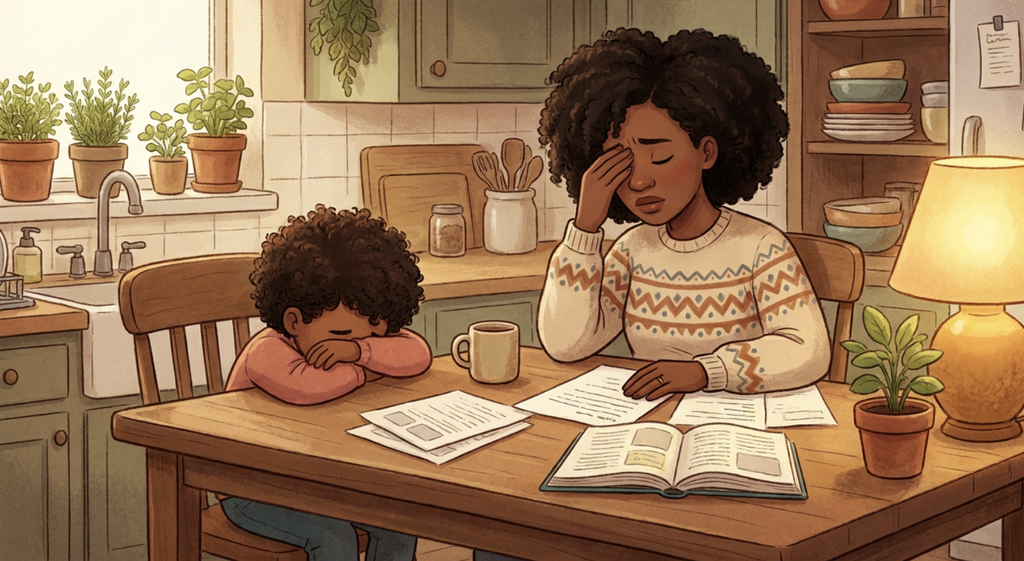
Yesterday was a hard day.
I don’t say that as a preface to something inspirational. I say it because it was just….hard. And I think sometimes, people just need to hear someone else say those exact words.
It started simply enough. When my 10-year-old asked for a 20-minute break before starting her homework, it felt like a win-win. She got to decompress, and I got a dedicated block of time to power through my own busy to-do list. But busy turned into distracted. Neither of us kept track of the time, and suddenly we were staring down the evening with zero progress made. Starting a heavy load of homework that late is a recipe for disaster; by the time we finally sat down, we were both already completely drained.
At first, the friction was small. It was me repeating the instructions, and her not quite comprehending, or perhaps not wanting to engage at all…I wasn’t sure which. It was a look, a sigh, and me trying again and again and again…. Her frustration started to surface, and mine began to build quietly underneath it. Back and forth we went, small thing by small thing, disgruntled faces and short answers, until we were both fully in it…completely overwhelmed, neither of us able to get out of the way of the other.
Before long, she went into a full spiral. If you have a child who experiences this, you know it isn’t a simple tantrum. It’s not the cry of “I don’t want to do this”….it is the cry of pure, agonizing frustration. It is absolute despair. She was trapped on a psychological mouse wheel; even if she managed to calm down for a split second, the momentum would drag her right back in. We tried coping techniques, but nothing worked. The momentum was unstoppable.
For kids who can’t put words to this level of overwhelm, you see it entirely in the body. It’s the shutdown, the escalation, the crying, and the physical collapsing onto the floor. It is the physical manifestation of a child who is completely locked in a loop they cannot climb out of…experiencing the terrifying feeling of physically being unable to pull themselves out of the moment.
And there I was…having held it together all day, trying everything I knew…and nothing was landing. She couldn’t hear me. I couldn’t reach her. Even as an experienced BCBA, I wanted to go sit in the closet and cry.
Yesterday wasn’t just emotionally hard; it was neurologically hard. For an entire hour, we were two people in the same room, both experiencing a complete nervous system overload, trying and failing to find a way back to each other through the noise. Our brains were processing the overwhelm in completely different ways, making it feel like we were speaking two entirely different languages. There are layers to these moments that don’t fit neatly into any parenting book.
The next morning, I got up and put on a happy face.
I didn’t tell my team she was struggling. I didn’t say anything. I just showed up, smiled, and kept moving. And here’s the thing about doing that…it’s not just that you’re holding the hard stuff in. It’s that while you’re holding it in, you’re watching everyone around you seem fine. Everyone else looks like they have it together. Everyone else doesn’t seem to be struggling.
And that makes it worse.
Because now, on top of the hard night and the exhaustion, you’re also quietly concluding that you’re the only one. That other parents aren’t white-knuckling it. That somehow, everyone else got a version of this life that is easier than yours.
They didn’t. But you can’t see that from the outside.
I wonder how many of you do the exact same thing. You go to therapy drop-off, you give the update, and you say, “It’s been a rough week,” when what you really mean is, “I don’t know how many more rough weeks I have left in me.” You hold the real version inside because you’re not sure anyone actually wants to hear it, because saying it out loud makes it too real, or because you’re not sure what good it would do anyway.
You might ask yourself: I know that other parents struggle too…but what does that actually do for me? Does knowing that make it easier? Is this always going to be this hard? Can it get better? Am I doing the right things for my child? And underneath all of it, the quietest question of all: Where did I go? I need something for myself, I just don’t know where to find it.
I share my story not to compare my single, one-hour struggle to what so many of you face. For parents of children with autism or other developmental needs, this level of intense overwhelm isn’t a rare, one-off Tuesday. For many of you, it is every day. It is a constant, exhausting cycle that feels like it has no end. My hard afternoon was just a tiny window into a reality that many families live in permanently.
I want to bring light to this because you need to know you are not alone, and your providers should be a resource for you in these exact moments. As BCBAs and ABA providers, we are not licensed mental health counselors, and we cannot provide family therapy. But what we can do is listen, hear you, and walk alongside you. We can look at these incredibly difficult moments and help you modify the environment, find ways to reduce the intensity of these behaviors, and build concrete, actionable plans to help both you and your child navigate the storm. It is not hopeless, and you do not have to figure it out in isolation.
Whether you work with us or another provider, your team should be a safe harbor. They should be a place where you can openly communicate without judgment, and where professionals use evidence-based ABA practices to provide you with real, functional methods to make daily life easier. Your providers should bring both clinical expertise and deep compassion to the table—not just to collect data, but to help you find a sustainable path forward.
And lastly, compassion is not just a word we put on our website because it sounds good; it is the actual heartbeat of this practice. It’s in our therapists and in the way we were trained to show up. The therapy matters deeply—the progress, the goals, the data, and the growth. But so do you. The whole family matters, not just during the hours a therapist is in your home.
Please note: While we are here to support your family through behavioral planning and environmental modifications, we are not licensed mental health therapists. If you are experiencing severe burnout, depression, or need personal mental health support, we highly encourage you to reach out to a licensed professional counselor or family therapist who can provide those clinical services.
Pillars Behavioral Health walks alongside families in Texas, North Carolina, Tennessee, and Colorado — through the milestones and the hard Tuesdays. We’re here for both.
Leave a Reply