When your child runs away during clean-up time, throws their toy across the room, or melts down at the dinner table, it's easy to feel frustrated or confused. You might wonder, "Why are they doing this?" or "How do I make it stop?"
But here's the thing we want you to know: every behavior is your child trying to tell you something.
They're not being defiant or trying to make your life harder. They're communicating the only way they know how in that moment, and when we shift from "How do I stop this?" to "What is my child trying to tell me?", everything changes.
At Pillars Behavioral Health, we don't just focus on reducing behaviors. We focus on understanding the why behind them, so we can teach your child a better way to communicate what they need. And that starts with understanding the four functions of behavior.
What Does "Behavior Is Communication" Really Mean?
Think about it this way: before children have the words to say "I'm overwhelmed," "I need a break," or "I want to play with you," their bodies do the talking. A toddler who bolts from the table might be saying, "This is too much for me right now." A preschooler who grabs a toy from another child might be communicating, "I really want that, but I don't know how to ask."
Young children are still building the neural pathways for emotional regulation, sensory processing, and social communication. Their brains are developing at lightning speed, but they haven't yet mastered the skill of putting feelings into words. So they use what's available to them: their actions, their movements, their big emotions.
When we respond to those behaviors with curiosity instead of frustration, we teach them that their needs matter, and we help them build the skills to express those needs in healthier ways.

The Four Functions of Behavior (aka Why Kids Do What They Do)
In behavior therapy, we talk about something called the "four functions of behavior." It's a simple way to decode why a behavior is happening. Once you understand the function, you can teach a replacement skill that meets the same need in a more appropriate way.
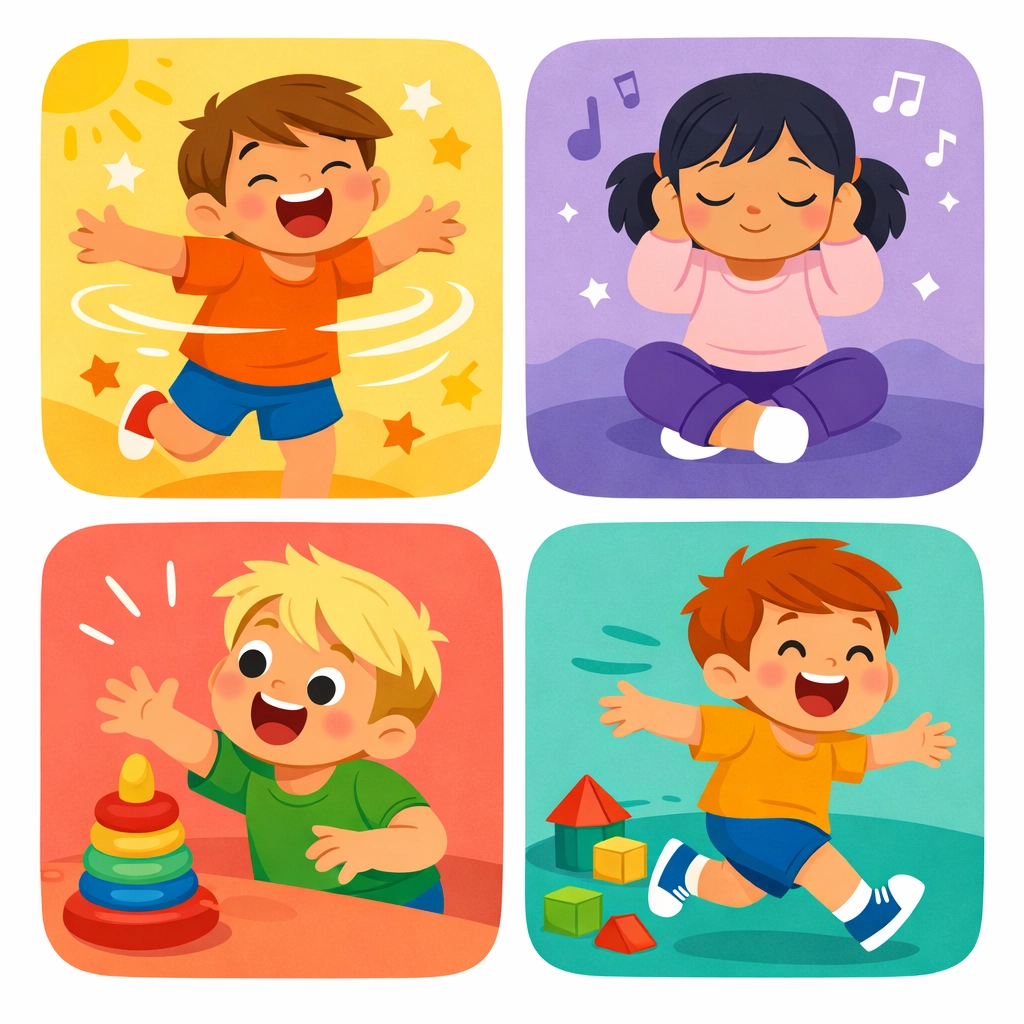
We use the acronym SEAT to remember them: Sensory, Escape, Attention, and Tangible. Let's break each one down with real-life examples you might see during play or everyday routines.
1. Sensory (Automatic): It Feels Good or Helps Them Regulate
Some behaviors happen because they provide sensory input that feels good to your child's nervous system, or because they help your child manage uncomfortable sensations.
What it looks like:
- Spinning in circles during playtime
- Chewing on toys, shirt collars, or pencils
- Humming or making repetitive sounds
- Jumping on the couch
- Covering their ears in loud environments
What they might be communicating:
"My body needs movement," "This helps me feel calm," or "That sound/light/texture is too much for me."
Our play-based approach:
Instead of saying "Stop spinning," we create opportunities for safe sensory input. Maybe we introduce a spinning chair during play, offer a chewy necklace, or build jumping into your child's routine through trampolines or obstacle courses. We meet the sensory need while teaching regulation.
2. Escape (Avoidance): They Want to Get Away From Something
Escape behaviors happen when your child is trying to get out of a situation that feels hard, boring, overwhelming, or uncomfortable.
What it looks like:
- Running away when you ask them to clean up toys
- Dropping to the floor when it's time to transition from playtime to mealtime
- Pushing materials away during a learning activity
- Saying "I can't" or "It's too hard" repeatedly
What they might be communicating:
"This task feels too big," "I don't know how to do this," "I need a break," or "I'm not ready yet."
Our play-based approach:
We don't force compliance. Instead, we make the activity more engaging, break it into smaller steps, or offer choices. For example, if a child runs from clean-up, we might turn it into a game: "Can you pass me the red blocks? Let's race to see who can put away the most cars!" We reduce the demand while still teaching the skill, and we honor the need for a break when they genuinely need one.
3. Attention: They Want to Connect or Interact
Attention-seeking behaviors happen when your child wants connection, interaction, or reassurance from you or others around them.
What it looks like:
- Calling your name repeatedly while you're on a phone call
- Showing you the same drawing or toy over and over
- Engaging in silly or unexpected behaviors that make people laugh
- Acting out when you're focused on a sibling
What they might be communicating:
"I want to be near you," "Notice me," "Let's play together," or "I need reassurance that you're still here."
Our play-based approach:
We don't see attention-seeking as a bad thing, connection is a core human need! Instead of ignoring the behavior, we teach appropriate ways to ask for attention: tapping your shoulder, using words like "play with me," or waiting for a brief moment. And we build in plenty of quality connection time so the need for attention doesn't build up in the first place.
4. Tangible: They Want a Specific Item or Activity
Tangible behaviors happen when your child wants access to something specific, a toy, a snack, screen time, or a preferred activity.
What it looks like:
- Grabbing a toy from another child's hands
- Crying or whining when you say "not yet" to the tablet
- Sneaking into the pantry for a snack
- Repeating "I want it, I want it, I want it"
What they might be communicating:
"I really want that thing," "I don't know how to wait," or "I don't have the words to ask the right way."
Our play-based approach:
We teach functional communication: how to ask, how to wait, and how to negotiate. During play, we might practice trading toys, using visual timers to show when it's time for a preferred activity, or teaching the phrase "Can I have a turn?" We help your child understand that they can have access to things they want, but they need to use their words (or alternative communication) instead of grabbing or melting down.

How Pillars Approaches Behavior: Compassion First, Always
Here's where our approach at Pillars is different. A lot of traditional ABA therapy focuses on stopping behaviors, using consequences, ignoring, or compliance-based methods to make the behavior go away. But we believe that's missing the point.
We don't want to just eliminate a behavior. We want to understand the need behind it and teach your child a better way to get that need met.
That's called functional communication training, and it's one of the most powerful tools we use. When a child learns to say "break, please" instead of running away, or "my turn" instead of grabbing, they're not just behaving better: they're building communication skills that will serve them for life.
We also prioritize co-regulation. Your child's nervous system is still developing, which means they often borrow regulation from the adults around them. When we stay calm, use gentle voices, offer deep pressure, or simply sit with them through a tough moment, we're teaching their body what regulation feels like.
And here's the best part: we do all of this through play. We're not drilling flashcards at a table. We're rolling cars, building block towers, playing chase, and following your child's lead. Because when therapy feels like play, kids are motivated, engaged, and learning without even realizing it.
What You Can Start Doing Today
You don't need to be a therapist to start decoding your child's behavior. Here are a few things you can try:
Ask yourself these three questions when a behavior happens:
- When does this behavior occur? (Time of day, during transitions, around certain people?)
- What's happening in the environment? (Is it loud, crowded, or overstimulating?)
- What does my child gain or avoid through this behavior? (Attention, escape, sensory input, or access to something?)
Respond with curiosity, not frustration.
Instead of "Stop doing that!" try "I see you're feeling frustrated. What do you need?" Even if they can't answer yet, you're modeling the kind of communication you want to build.
Offer simple choices.
"Do you want the blue cup or the red cup?" "Should we clean up blocks first or cars first?" Choices give children a sense of autonomy and control, which often reduces challenging behaviors.
Validate their feelings before redirecting.
"You really wanted that toy. I can see you're upset. Let's find a way to ask for a turn." Validation doesn't mean giving in: it means showing them that their feelings matter.
You're Not Alone in This
Parenting is hard. Parenting a child with big behaviors can feel overwhelming, especially when you're just trying to get through the day. But you don't have to figure it out alone.
At Pillars Behavioral Health, we're here to partner with you: in Texas and North Carolina: to help you understand what your child is communicating and how to respond in ways that build connection, trust, and skills. We believe every child is doing the best they can with the tools they have, and our job is to give them better tools.
If you're ready to move from "How do I stop this?" to "What is my child trying to tell me?", we'd love to walk alongside you. Reach out to our team to learn more about our compassionate, play-based approach to therapy.
Your child is communicating. Let's figure out what they're saying( together.)
Leave a Reply